Welcome to I.CH Motion Co., Ltd
- All
- Product Name
- Product Keyword
- Product Model
- Product Summary
- Product Description
- Multi Field Search

Views: 0 Author: Site Editor Publish Time: 2026-01-24 Origin: Site


Can a gearbox really hold position without help?
Many systems fail when reverse motion appears unexpectedly.Engineers often ask whether helical gears are self-locking or backdrivable.
In this article, you will learn how friction, efficiency, and design choices decide the answer.
Self-locking refers to a gear system’s ability to resist reverse motion when external torque is applied at the output shaft. If the load cannot drive the input shaft backward, the transmission is considered self-locking. This behavior is critical in systems where position stability is required after power loss. In many industrial applications, self-locking determines whether a mechanism can safely hold a load without additional devices.
In real mechanical systems, self-locking is not an absolute condition. It exists within a range of operating states rather than as a fixed property. Load direction, operating speed, lubrication conditions, and temperature all influence whether a gear will resist backdriving. Understanding self-locking therefore requires separating simplified theoretical models from real operating behavior. A gear may appear stable during testing but behave differently under dynamic loads.
Backdriving occurs when the output load forces the gear train to rotate in reverse. Gravity-driven loads are the most common cause, especially in vertical or inclined systems. Inertia from rotating masses also contributes, particularly during sudden stops or power loss. When these forces exceed the resisting torque in the transmission, reverse motion begins.
In lifting mechanisms, backdriving may cause uncontrolled descent. In indexing systems, it can lead to position drift and loss of accuracy. In automation equipment, backdriving reduces repeatability and may compromise safety. These issues often appear during sudden power loss, emergency stops, or load reversal events. Engineers must decide whether backdriving should be prevented mechanically or managed through control systems, and that decision strongly influences the overall transmission design.
Most conventional gears are optimized for efficient power transmission rather than torque holding. Their tooth profiles are designed to minimize sliding friction and heat generation. The pitch point is positioned in a region that favors rolling contact, which allows smooth engagement and disengagement of the teeth.
This geometry enables bidirectional torque flow and supports high-speed, continuous-duty operation. However, self-locking requires friction torque to exceed the applied load torque. In efficient gear designs, this condition is rarely achieved. As efficiency increases, reversibility becomes unavoidable. For this reason, efficiency and self-locking are often opposing design goals.
Helical gears occupy a middle ground among common gear types. They share the high efficiency of spur gears while introducing additional sliding due to their angled teeth. Compared with worm gears, helical gears generate far less friction. Compared with spur gears, they distribute load more smoothly and operate more quietly.
This balance makes helical gears well suited for continuous-duty drives, high-speed transmissions, and noise-sensitive machinery. At the same time, this same balance limits their natural self-locking capability. Under normal conditions, helical gears remain reversible and allow backdriving.
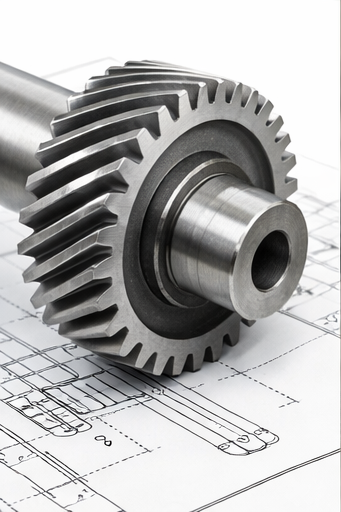
Standard helical gears are not self-locking. They allow backdriving under normal operating conditions. This statement applies to most industrial gearboxes as well as automotive and automation systems that rely on helical gearing for efficient power transmission.
Helical gears achieve high efficiency through gradual tooth engagement. Multiple teeth share the load at the same time, which reduces contact stress and vibration. Sliding friction remains relatively low, while rolling motion dominates the contact behavior between tooth flanks.
When efficiency exceeds roughly 90 percent, reversibility follows. Torque applied at the output shaft can rotate the input shaft with little resistance. Lubrication further reduces friction at the contact surfaces. Improved lubrication increases efficiency but weakens any potential locking effect. This explains why well-designed helical gear systems backdrive easily under load.
Quiet operation does not indicate self-locking. Noise reduction results from smooth meshing and gradual engagement, not from resistance to reverse motion. Likewise, high torque capacity does not imply torque holding. Helical gears can transmit large torques efficiently in both directions, but they do not inherently block reverse torque. Assuming self-locking based on torque rating alone often leads to incorrect design assumptions.
Self-locking behavior depends on a combination of geometric and frictional factors. No single design parameter determines whether a helical gear will lock under load. Instead, several factors interact to influence the outcome.
The friction angle defines resistance at the tooth interface and depends on material pairing and lubrication. For self-locking to occur, friction torque must exceed the applied load torque. In helical gears, friction coefficients are typically low. Common values range from approximately 0.03 to 0.08 (needs verification), which are insufficient to block reverse motion in most cases.
Under dynamic conditions, friction may decrease further. Vibration, surface polishing, and lubrication film effects reduce resistance over time. As a result, even marginal locking behavior may disappear during operation.
Pressure angle influences the direction of forces at the tooth contact. Higher pressure angles increase sliding forces and move the pitch point away from the optimal rolling zone. This shift raises resistance to reverse rotation and can improve locking potential.
However, higher pressure angles also increase contact stress and wear. Efficiency decreases and service life may be reduced. Designers must balance locking potential, efficiency, and tooth durability. Extreme pressure angles limit practical application.
Helical gears benefit from axial overlap, which increases the total contact ratio and improves load sharing. Higher helix angles enhance smoothness and load distribution but also introduce axial thrust forces. These forces increase bearing load and place greater demands on housing stiffness. System rigidity becomes critical when helix angles are increased to support locking behavior.
Parameter | Influence on Locking | Side Effects |
Friction coefficient | Direct | Heat, wear |
Pressure angle | Moderate | Stress increase |
Helix angle | Indirect | Axial thrust |
Even when gear geometry favors locking, operating conditions strongly influence actual behavior. Helical gears rarely operate in stable laboratory environments. Load direction plays a major role. A gear may resist backdriving under static load but reverse under shock or impact loading.
Speed also affects self-locking behavior. At low speed, friction dominates contact behavior. At higher speed, lubrication films become more effective and reduce friction, weakening any locking margin. Temperature further influences performance. Elevated temperature reduces lubricant viscosity, which lowers friction torque and may eliminate marginal self-locking behavior.
Surface finish also affects resistance to backdriving. Polished tooth flanks reduce friction, while rough surfaces increase resistance but accelerate wear. For these reasons, self-locking must be evaluated across the full load, speed, and temperature range. Locking under one condition does not guarantee locking under all operating states.
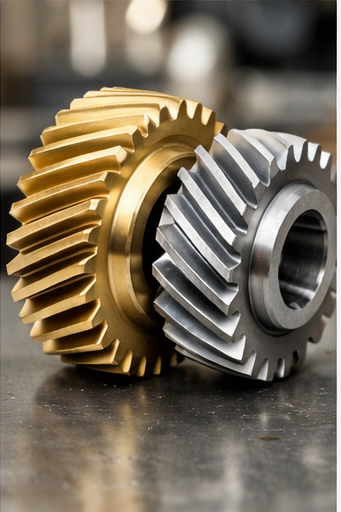
Helical gears can be engineered to achieve self-locking behavior, but doing so requires deliberate deviation from standard design practice. Such designs are specialized and application-specific.
Self-locking designs often use high pressure angle tooth profiles. Some designs employ asymmetric tooth flanks, which favor one direction of load. Asymmetric teeth improve locking capability while preserving forward-drive efficiency. Symmetric profiles may also be used, but they usually sacrifice more efficiency.
These gears require custom engineering and validation. They are not standard catalog products and must be designed for specific operating conditions.
Self-locking helical gears trade efficiency for control. They rarely match the efficiency of standard helical gears. Advanced designs may exceed 50 percent efficiency, which is significantly higher than typical worm gear efficiency. However, losses increase with load and speed, and thermal management becomes critical.
High pressure angles increase radial loads, while large helix angles raise axial thrust. Bearings must support higher forces, and housings must resist deformation. Alignment tolerances become tighter, and manufacturing precision directly affects performance and reliability.
Self-locking helical gears are sensitive to manufacturing variation. Small deviations in geometry can significantly change force balance. Pressure angle errors alter contact forces and shift pitch point location. Helix angle variation changes axial load and affects bearing friction.
Surface finish variation alters the friction coefficient, which means different production batches may behave differently under load. Assembly alignment also matters. Misalignment reduces effective contact area and makes locking behavior unpredictable. Reliable self-locking requires tight tolerance control, consistent surface finishing, and careful assembly procedures.
Worm gears rely on sliding-dominant contact. Their lead angle creates a wedging effect that blocks reverse motion. Friction prevents the worm wheel from driving the worm, making backdriving mechanically impossible. This behavior makes worm gears suitable for lifting and holding applications.
Helical gears offer much higher efficiency than worm gears. They support higher speeds and continuous duty cycles with lower heat generation. Lubrication requirements are simpler, and parallel shaft layouts ease system integration. Maintenance is generally easier and more predictable.
Some systems require partial locking while maintaining better efficiency than worm gears can provide. Examples include automated positioning stages, adjustable machine tooling, and compact robotic joints. In these cases, self-locking helical gears offer a balanced solution.
Feature | Helical Gears | Worm Gears |
Self-locking | Optional | Inherent |
Efficiency | High | Low |
Speed range | Wide | Narrow |
Heat generation | Low | High |
Positioning systems demand stability. Reverse motion reduces accuracy and repeatability. Self-locking helical gears provide mechanical holding and reduce reliance on brakes. This improves repeatability and simplifies control design.
Rotating systems store kinetic energy. Sudden power loss releases this energy and may cause backdriving. Self-locking designs block this motion, protecting motors and sensors while improving overall system safety.
High-duty-cycle drives require high efficiency. Continuous losses increase operating cost. Bidirectional motion requires reversibility, and self-locking interferes with precise motion control. In such cases, external holding solutions often perform better.
Despite technical feasibility, many engineers avoid self-locking helical gears in production systems. Self-locking reduces system flexibility and complicates commissioning. Wear changes behavior over time, as polished surfaces reduce friction and locking margins.
Maintenance becomes more sensitive, since lubrication changes affect performance. Custom gear geometry increases cost and validation effort. For these reasons, many systems prefer standard helical gears combined with external brakes, clutches, or control-based holding solutions.
Selecting self-locking helical gears requires system-level evaluation.
Is backdriving unacceptable under all conditions? What efficiency loss is tolerable? Can bearings support higher loads? Clear answers guide design decisions.
Mechanical brakes provide reliable holding and engage only when needed. Clutches allow selective load isolation while preserving gear efficiency. Control-based holding uses motors and feedback, adding flexibility at the cost of complexity.
Requirement | Standard Helical Gears | Self-Locking Helical Gears | Worm Gears |
Backdriving prevention | No | Yes (design-dependent) | Yes |
Efficiency | Very high | Medium–high | Low |
Shaft arrangement | Parallel | Parallel | Crossed |
Helical gears are not self-locking by default.
They can become self-locking through intentional design choices.Self-locking is a design decision, not a natural feature.
Engineers must evaluate efficiency, function, and system limits together.This article serves as a practical decision reference.
With engineered solutions from I.CH Motion, gear systems deliver reliable performance and value.
A: No. Helical gears are designed for efficiency and smooth motion, so they usually allow backdriving.
A: Helical gears have low friction and rolling-dominant contact, which makes reverse rotation possible.
A: Yes. Helical gears can be made self-locking through special tooth geometry and higher pressure angles.
A: Helical gears offer higher efficiency, while worm gears provide natural self-locking but lower efficiency.
A: Helical gears should not be forced to self-lock in high-duty or bidirectional applications.