Welcome to I.CH Motion Co., Ltd
- All
- Product Name
- Product Keyword
- Product Model
- Product Summary
- Product Description
- Multi Field Search

Views: 0 Author: Site Editor Publish Time: 2026-01-26 Origin: Site


Helical gears run smoothly and quietly.
But does silence mean less maintenance?Lubrication is a critical question for helical gears.
It controls friction, heat, and long-term reliability.In this article, you will learn when lubrication is required, how it works, and what happens if it fails.
Helical gears are characterized by teeth cut at an angle relative to the gear axis. This angled geometry allows the teeth to engage gradually across the face width, which reduces impact loading and improves smoothness during power transmission. As torque is transferred progressively rather than abruptly, vibration and noise are significantly reduced compared to straight-tooth designs.
However, the same angled geometry introduces a continuous sliding component during meshing. Unlike spur gears, where contact near the pitch line is dominated by rolling motion, helical gears experience sliding along most of the tooth flank from entry to exit. This sliding occurs under normal operation even when alignment, load, and installation are correct.
Sliding contact inevitably generates friction, and friction converts mechanical energy into heat. As rotational speed increases, sliding velocity rises accordingly, which intensifies heat generation at the tooth surface. Because sliding cannot be eliminated in helical gears, lubrication becomes essential. The lubricant must form a stable film that separates metal surfaces under both rolling and sliding conditions. Without this separation, microscopic surface asperities interact directly, leading to rapid wear even at moderate loads.
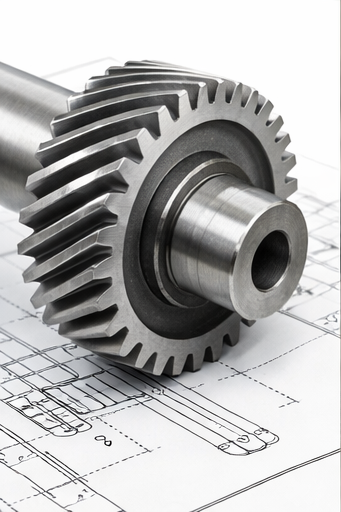
One of the key advantages of helical gears is their ability to distribute load across multiple teeth simultaneously. This load-sharing characteristic reduces peak stress on individual teeth and improves overall durability. Compared to spur gears, the stress concentration at any single contact point is lower, which supports higher load capacity.
At the same time, the duration of contact for each tooth increases. Because multiple teeth remain engaged over a longer arc of rotation, each tooth stays under load for a longer period. This extended contact time increases cumulative surface stress and places greater demands on lubrication performance.
To maintain separation between mating surfaces, the lubricant film must remain stable throughout the entire contact zone. Film stability depends on lubricant viscosity, contact pressure, and relative sliding speed. If viscosity is too low, the film collapses under load. If oil supply is inconsistent, starvation occurs. In both cases, surface fatigue begins below the visible surface and progresses rapidly once initiated.
Quiet operation often leads to incorrect assumptions about gear stress. Helical gears produce less noise than spur gears, which can mask early signs of surface distress. Many operators associate low noise with low wear, but this relationship does not hold true for helical gear systems.
Sliding velocity is the primary hidden driver of lubrication demand. As speed, torque, and helix angle increase, sliding velocity rises and frictional heat generation accelerates. Damage typically begins at the microscopic level and progresses silently. By the time noise or vibration becomes noticeable, surface damage is often already advanced. This is why lubrication demand for helical gears is higher than many users initially expect.
In real industrial applications, helical gears require lubrication in most operating conditions. Lubrication is essential when gears operate in enclosed housings, when tangential speed reaches medium or high levels, and when loads are continuous rather than intermittent. These conditions represent the majority of industrial gear systems.
Gear designers assume the presence of lubrication when selecting tooth geometry, surface finish, and materials. Operating helical gears without lubrication violates these design assumptions and significantly increases the risk of premature failure. For this reason, lubrication should be considered a functional requirement rather than optional maintenance.
Certain operating conditions sharply increase lubrication demand. Elevated operating temperatures reduce lubricant viscosity, which weakens the oil film and limits its ability to support contact stress. Long duty cycles prevent adequate cooling recovery, allowing heat to accumulate in the gear mesh. Precision transmission systems further magnify the impact of lubrication quality, as even minor surface wear can affect backlash, efficiency, and positional accuracy.
In these situations, lubrication quality directly controls performance stability. Poor lubrication leads to accelerated wear, efficiency loss, and increased vibration, even when gears are properly aligned and manufactured to specification.
Minimal lubrication is limited to specific and controlled scenarios, such as very low-speed operation, light and predictable loads, and intermittent motion with sufficient cooling periods. Even in these cases, wear still occurs and service life is reduced compared to fully lubricated systems.
Choosing minimal lubrication represents an engineering trade-off. It simplifies maintenance in the short term but increases long-term replacement costs. For most industrial applications, this trade-off is not justified.
One of the primary functions of lubrication is to reduce friction between mating teeth. Lower friction directly reduces heat generation at the contact surface. In helical gears, heat originates from the combined effects of rolling and sliding motion, which intensify as speed increases.
As temperature rises, lubricant viscosity decreases. Once viscosity drops below a critical threshold, film strength fails and surface separation can no longer be maintained. Effective lubrication not only reduces friction but also transports heat away from the contact zone, which becomes increasingly important in high-speed or high-load applications.
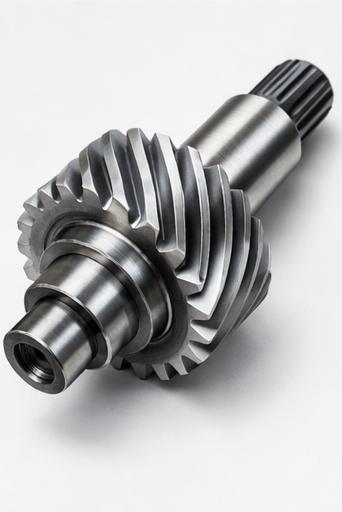
Insufficient lubrication leads to predictable and well-documented failure modes. Scuffing occurs when metal surfaces briefly weld together and tear apart, leaving streaks along the tooth flank. Micropitting develops from repeated surface fatigue, forming small pits that grow under cyclic stress. Macropitting results from subsurface crack propagation and causes visible material loss.
All of these damage mechanisms accelerate when lubrication is inadequate. Proper lubrication delays their onset and slows their progression, extending gear service life.
Lubrication quality has a direct and measurable impact on gear reliability. A well-lubricated system can tolerate minor misalignment, load variation, and thermal fluctuation. In contrast, a poorly lubricated system may fail rapidly even when alignment and installation are correct.
For this reason, lubrication should be treated as a design parameter rather than a routine maintenance task. Decisions about lubrication method, viscosity, and monitoring strategy directly influence system reliability.
Grease lubrication is suitable for low-speed and light-load systems, including open gear arrangements and intermittent drives. Grease adheres well to tooth surfaces and provides sealing against contamination, which makes it attractive in exposed environments.
However, grease dissipates heat poorly and degrades under continuous motion. At higher speeds, temperature rises rapidly and grease loses its protective properties. Over-greasing further increases viscous drag, reduces efficiency, and accelerates thermal buildup.
Splash lubrication relies on rotating gears to distribute oil within an enclosed housing. This method requires a minimum operating speed to be effective and depends heavily on correct oil level control. Excess oil increases churning losses, while insufficient oil leads to starvation.
As speed increases, oil temperature rises and viscosity decreases. In many cases, additional cooling features are required to maintain stable operating conditions. Splash lubrication remains common but has clear limits at higher speeds and loads.
Forced lubrication systems deliver oil directly into the gear mesh using drop, spray, or oil mist methods. These systems support high-speed helical gears by providing controlled lubrication and active cooling. Filtration and temperature regulation further enhance stability and reliability.
Although system complexity and cost increase, forced oil circulation offers the highest level of protection and performance consistency for demanding applications.
Lubrication Method | Suitable Speed | Load Capacity | Cooling Ability | Typical Applications |
Grease lubrication | Low speed | Light load | Low | Open gears, intermittent drives |
Splash lubrication | Medium speed | Medium load | Moderate | Enclosed gearboxes |
Forced oil circulation | High speed | Heavy load | High | High-speed and precision systems |
Viscosity selection determines lubricant film strength and energy efficiency. Lower viscosity oils reduce viscous drag and improve efficiency, while higher viscosity oils improve surface protection under heavy loads. The correct choice balances these competing requirements based on operating speed, load, and temperature.
Selecting an inappropriate viscosity results in either excessive wear or unnecessary power loss, both of which reduce system performance.
Operating Condition | Recommended Viscosity | Key Consideration |
Low speed, light load | Low viscosity oil | Reduce drag losses |
Medium speed, steady load | Medium viscosity oil | Balance protection and efficiency |
High speed, heavy load | High viscosity oil | Maintain film strength |
High temperature | Temperature-stable oil | Prevent viscosity breakdown |
Lubricants degrade during operation due to oxidation, thermal stress, and additive depletion. Visual inspection alone cannot detect these changes. Oil analysis provides insight into viscosity shifts, contamination, and additive condition, enabling predictive maintenance.
Condition-based monitoring improves reliability and reduces unplanned downtime compared to fixed maintenance intervals.
Solid particles cause abrasive wear, while water promotes corrosion and chemical degradation of lubricants. Contamination accelerates lubricant breakdown and shortens gear life. Effective filtration and sealing are essential for maintaining lubricant integrity and consistent protection.
Lubrication reduces friction losses but introduces viscous resistance. Proper selection minimizes total losses and improves energy efficiency. Poor selection increases heat generation and energy consumption, raising operating costs over time.
Lubrication smooths tooth engagement and reduces vibration transmission through the gear system. Lower vibration results in reduced noise and lower bearing loads. Acoustic performance often reflects lubrication quality and consistency.
Lubrication functions as a preventive engineering measure. It extends service life, reduces downtime, and lowers replacement frequency. Inadequate lubrication increases total ownership cost and leads to earlier system failure.
Lubrication Condition | Friction Level | Noise | Wear Rate | Service Life |
Proper lubrication | Low | Low | Minimal | Long |
Under-lubricated | High | Rising | Rapid | Short |
Over-lubricated | Moderate | Stable | Moderate | Reduced |
Many systems continue using familiar lubricants even as operating conditions evolve. Speed, load, and temperature often increase over time, while lubrication strategy remains unchanged. This mismatch creates unnecessary risk and accelerates wear.
Each lubrication method has defined operating limits. Grease fails at high speed, while oil bath lubrication struggles under extreme temperature conditions. Applying a method outside its intended range leads to rapid degradation and failure.
Lubricants age even without visible contamination. Additives deplete and viscosity shifts over time. Old oil may appear normal but no longer provides adequate protection, leaving gears vulnerable to accelerated damage.
In most real applications, helical gears do require lubrication.
Proper lubrication reduces friction, controls heat, and prevents surface damage.
It also helps maintain efficiency, low noise, and long service life.This makes lubrication a design necessity, not optional maintenance. I.CH Motion delivers reliable motion products designed for durability and stable performance, helping customers reduce risk and improve long-term value.
A: Yes. Helical gears require lubrication in most industrial systems to manage sliding contact, control heat, and prevent premature wear.
A: Helical gears generate sliding friction along the tooth face, which increases heat and makes lubrication more critical than for spur gears.
A: Helical gears may operate briefly at very low speed without lubrication, but wear increases and service life is reduced.
A: Poor lubrication causes helical gears to suffer scuffing, pitting, higher noise, lower efficiency, and early failure.
A: Helical gears in enclosed gearboxes are typically lubricated using oil bath or forced oil circulation systems.
A: Grease lubrication works for helical gears at low speed and light load, but it is unsuitable for high-speed operation.